
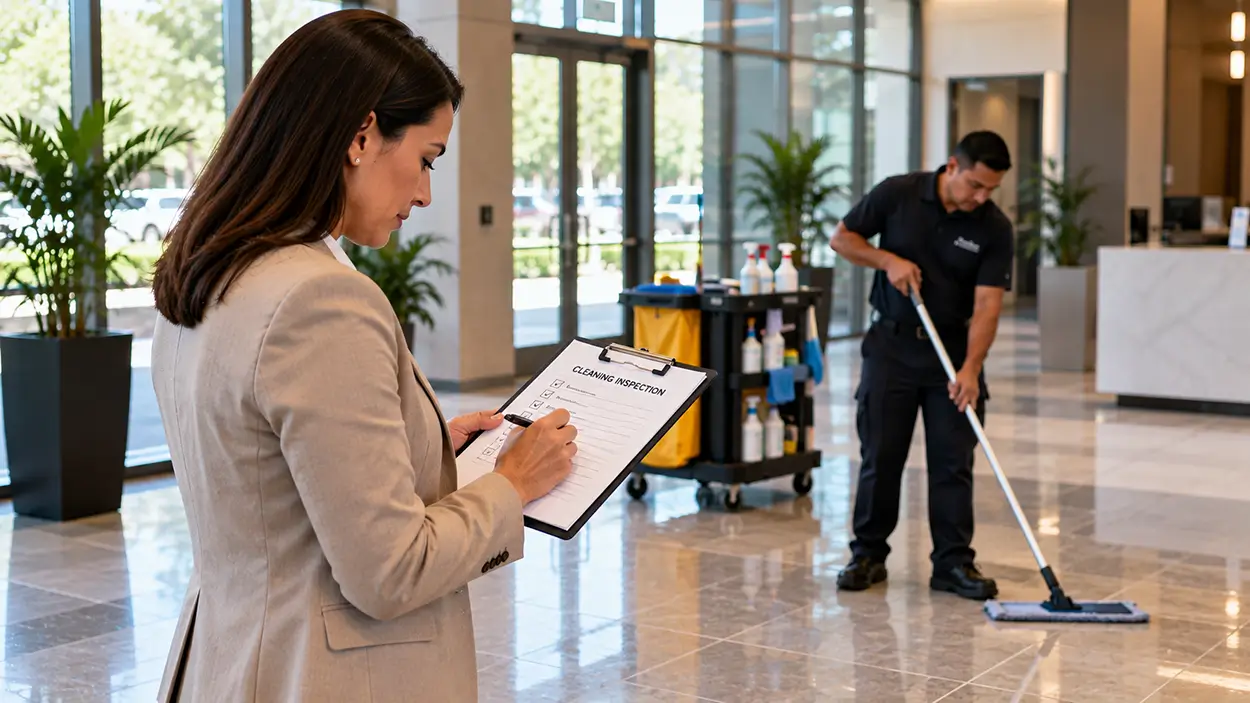
A cleaning program can look fine on paper and still drift over time. The agreed tasks may be getting checked off, yet complaints keep returning about the same restroom, floor edges are gradually being missed, or a periodic task quietly disappears from the routine. For a facility manager, the challenge is not simply noticing that something feels off. It is knowing how to evaluate the service fairly and consistently.
A commercial cleaning quality control checklist should help you compare the actual result against the agreed scope. It should not become another room-by-room cleaning list or a vague scorecard based on whether a space looks clean. The most useful inspection process connects what was promised, what was observed, what needs correction, and whether the correction actually happened.
Start With the Agreed Scope
Quality control begins with the service agreement, not with personal preference. If interior glass is scheduled monthly, it would be unfair to fail a nightly inspection because that glass was not cleaned that evening. The same applies to periodic floor work, high dusting, carpet extraction, or other tasks that may sit outside the recurring schedule.
Before inspecting, make sure you know which tasks belong to the current service period and which do not. That keeps the review focused on performance rather than turning it into a wish list of everything the facility might eventually need.
The scope also gives you a baseline for accountability. If a task is repeatedly missed even though it is clearly included, you have a performance issue. If the task was never included but is now becoming important because the building has changed, you may have a scope issue instead.
Inspect Outcomes, Not Just Completed Tasks
A checklist that only asks whether a task was completed can hide quality problems. “Vacuum lobby” may be marked done, but visible debris remains along the edges. “Service restroom” may be checked off even though dispensers were not refilled. The task happened, but the expected result was not achieved.
A better inspection looks at observable conditions. Are the agreed surfaces free of visible soil? Are supplies replenished where required? Are recurring trouble spots improving or staying the same? Has the cleaner addressed the details that were previously reported?
This approach makes feedback more useful because it focuses on results rather than assumptions about effort. It also gives the cleaning team something specific to correct.
Watch for Patterns, Not One-Off Imperfections
One imperfect night does not automatically mean the cleaning program is failing. Buildings are active spaces. A late meeting, unexpected foot traffic, a plumbing issue, or a delivery after the cleaning shift can affect how an area looks the next morning.
What matters more is whether the same issue keeps appearing. If restroom odor, floor-edge soil, missed trash, or supply shortages show up repeatedly in inspection notes, that is a pattern worth addressing. A consistent inspection process helps separate an isolated miss from a recurring quality problem.
Looking at several inspections together is especially useful when different supervisors or shifts are involved. It can reveal whether a problem is tied to one area, one task, or one part of the schedule instead of assuming the entire service is inconsistent.
Document Deficiencies Clearly
“Cleaning was bad” is difficult to act on. A useful quality note should identify the location, the condition observed, and the expected standard. That creates a record the service team can understand without guessing what the complaint means.
For example, “third-floor break room, visible debris under the counter after scheduled floor service” is much more actionable than “floor not clean.” The same principle applies to restrooms, glass, touchpoints, supply restocking, or periodic work.
Clear documentation also reduces friction. It keeps the conversation centered on the work instead of on blame, and it gives both the facility manager and the cleaning provider a shared reference point for follow-up.
Close the Corrective-Action Loop
Finding a problem is only half of quality control. The other half is confirming that the issue was corrected and did not simply disappear from the conversation.
A simple process can include the date reported, the area affected, the correction requested, who is responsible, and whether the issue was verified after follow-up. If the same deficiency returns, that history helps show whether the problem is training, supervision, staffing, equipment, or a mismatch between the scope and the building’s current needs.
This is where quality control becomes more useful than a one-time inspection. It creates a feedback loop instead of a list of complaints.
Separate Service Failure From Scope Failure
Some quality issues are not really failures of execution. A building may be busier than when the contract began, a new tenant may increase traffic, or a break room may now serve twice as many people. If the service plan has not changed with the facility, the cleaner may be completing the agreed scope while the result still falls short of what the building now requires.
That is why a quality audit should ask two different questions: Was the work performed as agreed? And is the agreed scope still enough?
Keeping those questions separate avoids unfairly blaming the cleaning team for a plan that no longer fits. It also helps facility managers decide whether they need better performance, a different frequency, or an added periodic task.
Use Joint Walkthroughs to Improve Accountability
Periodic walkthroughs with the cleaning provider can be more productive than relying only on email complaints. A shared inspection lets both sides see the same condition, compare it with the agreed standard, and discuss what should happen next.
The goal is not to turn every walkthrough into a fault-finding exercise. It is to make expectations visible. A provider should know what the facility manager considers acceptable, and the facility manager should understand what belongs to the current scope.
Over time, those conversations can also reveal where the plan needs adjustment. A consistently clean area may need less attention, while another may need more frequent service or a different method.
Build a Quality-Control Routine That Is Simple Enough to Use
An inspection system only works if people actually use it. A complicated scorecard with dozens of fields may look impressive but become burdensome after a few weeks. A shorter routine that captures the right information is often more valuable.
Focus on the agreed tasks, observable results, recurring misses, corrective action, and follow-up. Review patterns over time instead of treating each inspection as an isolated event.
That gives you a practical record of service quality without drifting into a second cleaning checklist or duplicating the original scope. It also keeps the audit focused on performance rather than expanding the cleaning scope by accident..
Keep Commercial Cleaning Accountable With Astro Cleaners
If your current cleaning program is difficult to evaluate because expectations, inspections, and follow-up are not clearly connected, Astro Cleaners can help create a more accountable service process. Astro Cleaners provides commercial cleaning services for Houston-area businesses with customized plans and ongoing quality oversight. A walkthrough can help clarify service standards, recurring trouble spots, and whether the next step is a performance correction or a scope adjustment.