
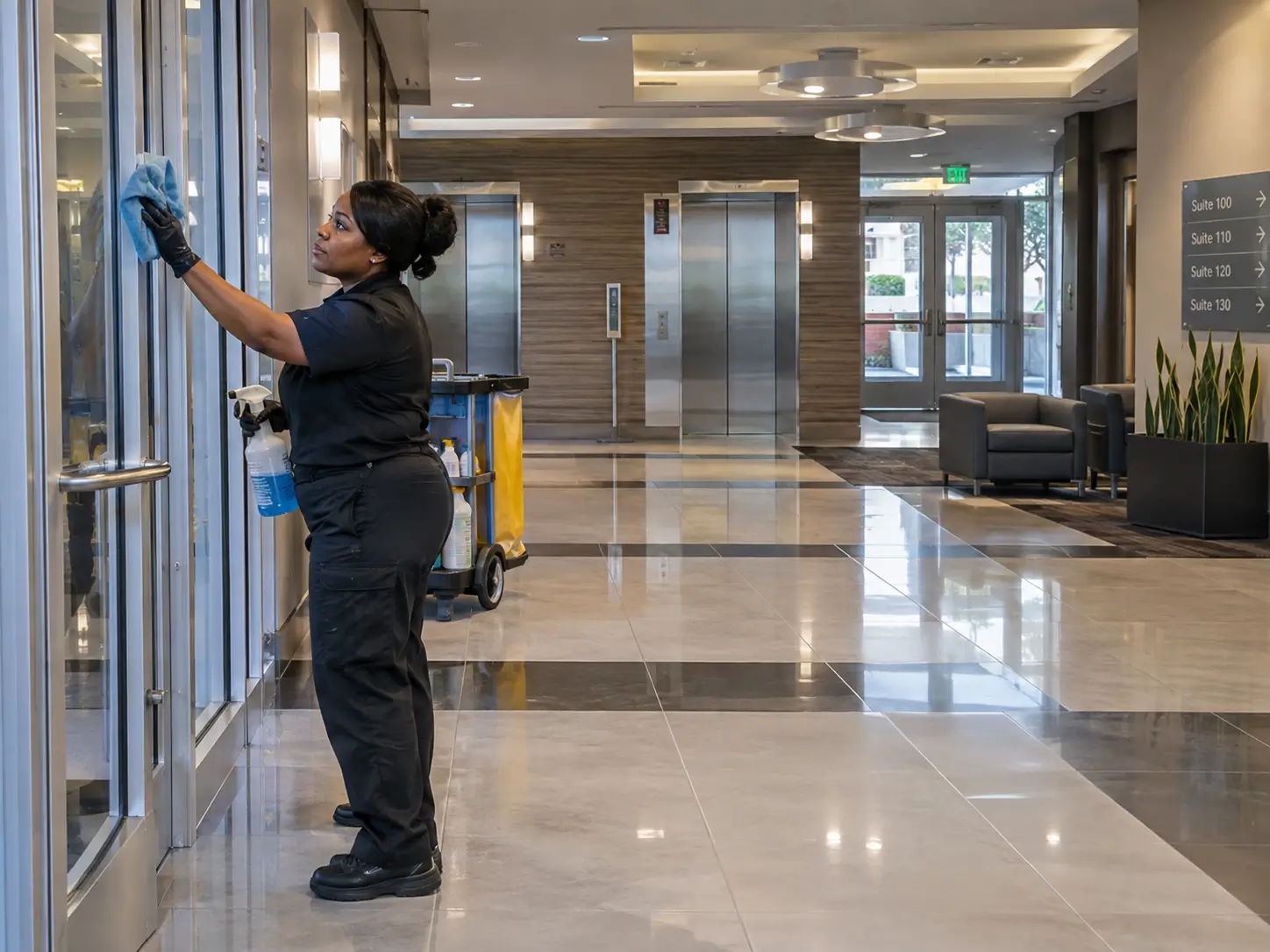
At 8:15 on a wet morning, the lobby may already tell you more about the building than the overnight checklist does. There is grit at the entrance, a delivery driver has propped the door open twice, and the floor mat has shifted far enough to look sloppy. Upstairs, the second-floor restroom is fine. By noon, those conditions may be reversed.
That is the difficulty with multi-tenant office cleaning: the building changes while people are using it. Several businesses share the same entrances, elevators, restrooms, corridors, and stairwells, but they do not create traffic in the same way or at the same time. A cleaning plan that works well on paper can still feel slightly out of step once the day gets busy.
For a property manager, the goal is not to make every surface look untouched from opening to close. That would be unrealistic and expensive. The better goal is steadiness: shared spaces should feel cared for, supplies should be there when people need them, and small messes should not be allowed to sit long enough to become the thing tenants remember.
Start With What the Building Actually Does
Before changing frequencies or adding service, it helps to spend a little time watching the property. Not in a formal inspection with a clipboard. Just notice what happens between the time tenants arrive and the time the building settles down.
Which entrance takes the brunt of the morning rush? Does one elevator bank stay busy because of a large tenant upstairs? Are there floors where visitors wait in the corridor before meetings? Does the restroom nearest a training room look fine most days but fall behind every Thursday afternoon?
Those details matter more than a generic square-footage formula. A small area can create more work than a large one if people are moving through it constantly. The opposite is true too: a long hallway on a quiet floor may need very little beyond routine attention.
Patterns usually emerge quickly. One property may need a lobby touch-up after the morning rush. Another may get more value from a restroom check at 1:00 p.m. than from adding a second full cleaning at night. That is where a cleaning plan starts to feel like it belongs to the building instead of being borrowed from somewhere else.
There is also a practical benefit to this approach. It keeps managers from spending money everywhere just because one or two spaces are struggling. If the problem is specific, the solution can be specific too.
The Spaces People Notice Are Not Always the Biggest Ones
Most tenants will not study whether a floor was vacuumed in straight lines. They will notice what affects them directly.
The lobby is an obvious example. It can be perfectly clean and still look untidy because the entrance glass is smudged, a waste bin is close to full, or the mats have shifted. Those are small things, but the lobby is where people slow down, wait for a ride, greet a client, or decide what they think of the property.
Restrooms carry even more weight because people use them privately and repeatedly. A restroom that was cleaned thoroughly at 6:00 a.m. can still feel neglected at 2:00 p.m. if soap is low, paper has collected on the floor, or water is sitting around the sinks. Technically, the scheduled cleaning happened. From the tenant’s point of view, that may not matter much.
This is where a midday check can be more useful than a blanket increase in service. On one floor, it may take only a few minutes to straighten the space, restock supplies, and wipe down the sink area. On another floor, no extra visit may be needed at all.
Elevators fall into the same category. They are small, enclosed, and used by almost everyone. Fingerprints, floor debris, and marks on doors are more visible there because people stand close to them with nothing else to look at. A corridor can hide a little wear. An elevator rarely can.
Timing Matters More Than It Looks
Cleaning after hours sounds straightforward until you manage a building where “after hours” means something different to every tenant.
One office may be empty by 4:30. Another may still have employees on calls at 7:00. A financial office could be meeting with clients late in the day, while a medical or therapy tenant may start early the next morning. If crews move through the property in the same order every night, someone is eventually going to feel interrupted.
It does not take much to avoid that. Certain floors can be cleaned earlier, others later. Noisy work can be saved for times when conference rooms are empty. A cart can be staged somewhere less conspicuous when a tenant is hosting visitors.
These decisions are small, but they influence how professional the service feels. Tenants do not need to know the schedule in detail. They simply notice when cleaning seems to happen around them instead of on top of them.
The same thinking helps with daytime issues. A spill by the elevator is not a sign that the building is badly cleaned. Neither is a trash bin that fills after an office lunch or a restroom that runs out of paper during a training session. Shared buildings are active places, and activity creates mess.
What matters is whether there is a reasonable way to respond. In a smaller property, that might be one scheduled check. In a busier building, it may make sense to have more frequent daytime coverage. The right answer depends on what keeps happening, not on what sounds impressive in a proposal.
Do Not Wait for the Quiet Areas to Become Obvious
Some parts of a building announce their problems quickly. Others can go a long time without attracting attention.
Stairwells are a good example. They may be used lightly for weeks, especially if most people take the elevator. Then a fire drill, elevator outage, or health-conscious tenant suddenly sends more traffic through them, and the dust on the rails or debris on the landings is impossible to miss.
The answer is not to clean every stairwell every day. It is to give low-traffic spaces a place in the rotation so they do not disappear from view. Side entrances, service corridors, upper-floor corners, and little-used common rooms all benefit from that kind of deliberate attention.
Periodic work belongs in the same conversation. Carpet extraction, deeper floor care, interior glass, high dusting, and detailed cleaning around fixtures usually do not become urgent overnight. They become urgent because they were easy to postpone for too long.
A calendar helps. If there is a quieter week coming up, that may be the right time for floor work. If a tenant is moving out, it may be a good opportunity to address nearby common areas while traffic is already disrupted. Planning around the life of the property is usually easier than waiting until wear becomes visible enough to force the issue.
Tenant Feedback Is More Useful Than It First Appears
No one wants a complaint email, especially when the concern feels minor. But a repeated complaint is often a clue that the current schedule is missing something.
If the same restroom keeps coming up, the problem may not be poor cleaning. It may be the time of day it is being serviced. If one entrance always looks worn by late afternoon, perhaps that doorway is carrying more traffic than anyone realized. If tenants repeatedly mention an elevator, that area may need more frequent attention than the surrounding hallway.
The hard part is separating a one-time issue from a pattern. That is easier when tenants know how to report concerns and management has one place to track them. Otherwise, one problem gets mentioned to reception, emailed to a manager, and repeated directly to a cleaner, creating the impression of three separate problems.
A calm response works better than a dramatic one. Fix what needs fixing, notice whether it happens again, and adjust the plan if the evidence points that way. Not every complaint calls for more service, but repeated concerns should not be ignored simply because the nightly checklist was completed.
There is a trust element here too. Tenants do not expect a commercial building to be spotless every second of the day. They do expect recurring problems to be noticed and addressed.
Walk the Property Without Trying to Inspect It
One of the simplest ways to understand the building is to move through it the way a tenant does.
Come in through the main entrance. Stand in the elevator for a few seconds. Walk past the suite doors. Use a shared restroom. Look at the places your eyes naturally go instead of searching for defects.
That kind of walkthrough often reveals things a formal checklist misses. A hallway can be technically clean but still feel neglected because the same wall marks have been there for months. A lobby bin may not be full enough to trigger service, yet it may look unpleasant from the seating area. A restroom may meet the stated frequency and still feel tired every afternoon.
Those are not always big cleaning failures. Often, they are signs that the service plan needs a small correction.
Buildings change, too. A tenant grows. Another starts hosting more visitors. A quiet floor becomes active after a move-in. The plan that worked six months ago may still be decent, but it may no longer be the best fit.
Keep Your Multi-Tenant Office Building Ready With Astro Cleaners
A well-kept shared building is usually the result of good judgment more than rigid frequency. Astro Cleaners provides professional cleaning for multi-tenant office buildings in Houston, with service plans built around traffic, tenant schedules, shared-space needs, and the way the property actually operates.
Our multi-tenant office building cleaning services can help maintain lobbies, restrooms, hallways, elevators, stairwells, and other common areas without treating every part of the building the same. The aim is simple: a practical cleaning routine that supports the property, respects the people using it, and gives management fewer problems to chase.